Ir Pol HUART
Alluvial
gold
was
mined
during
the
colony,
before
1960,
by
4
colonial
companies.
At
that
time,
most
of
the
prospectors
was
involved
in
alluvial
and
veins
of
quartz
and
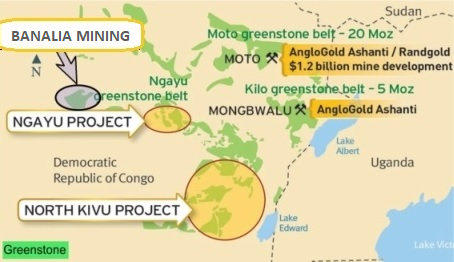
ignored the dissiminated gold.
The
most
attractive
deposits
in
the
region
are
disseminations.
They
occur
in
chemically responsive rocks.
Gold
reacts
in
BIFs
(Banded
Iron
Formation)
in
a
combination
of
chemical
barrier
(iron oxides) and the high tectonic competence of the rocks.
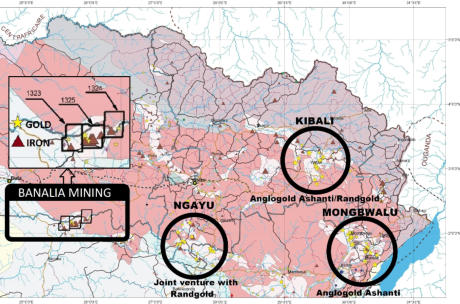
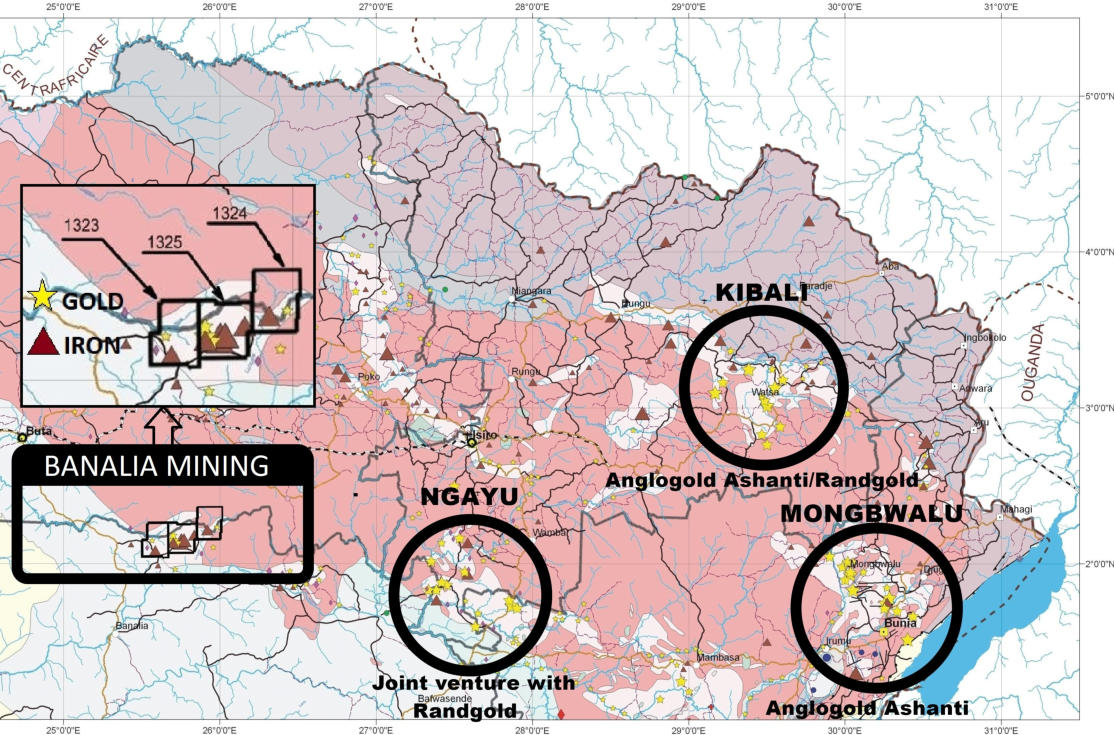
These
mining
permits
cover
the
same
geological
environment
as
the
well
known
gold
deposits in eastern of DRC.
This
unexplored
gold
deposit
should
interest
mining
companies
at
a
time
where
gold
is being discovered at a fraction of the rate needed to replenish reserves
Models and Exploration Methods for Major Gold Deposit Types
Gold project (target 2MozAu)
Maintain the best relations with the artisanal miners
This project is part of the World Bank's policy of leading the Mining Sector Support Project, called PROMINES (cf
http://www.prominesrdc.cd/
)
On
the
report
on
Improving
Artisanal
and
Small-scale
Gold
Mining
in
the
DRC
published
on
http://www.prominesrdc.cd/fr/Rapport/PROMINES
KEVIN TELMER final.pdf,
we read:
"It
is
estimated
that
about
80%
of
DRC's
gold
comes
from
informal
operations
of
artisanal
gold
mining,
although
the
actual
production
figure
is
unknown.
If
an
official
figure
of
industrial
gold
production
of
10
tonnes
is
used,
the
implication
would
be
that
the
artisanal
sector
produces
80%
more, thus 50 tons of gold." We believe that artisanal production is much more important..
Congolese
legislation
has
created
very
favourable
conditions
for
bringing
artisan
diggers
together
in
cooperatives.
It
is
still
necessary
to
motivate
the
diggers
to
join
these
cooperatives
which
allows
to
leave
the informal domain and join the formal domain that benefits the development of the country.
The
only
way
to
do
this
is
to
provide
the
cooperative
with
the
right
techniques
for
exploitation
and
recovery
as well as the right equipment to drastically increase productivity per digger.
First,
alluvials
or
evaders
must
be
prospected
by
wells
to
establish
the
depth
of
the
unsealed
gravel
and
the
height of the mineralized gravel.
The
non-mineralized
cover
must
be
moved
to
an
already
exploited
area
while
mineralized
gravel
must
be
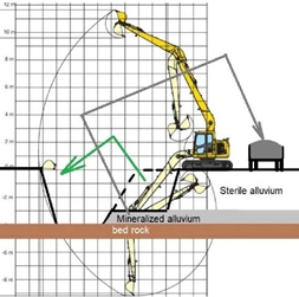
transported to a concentration station where water is available.
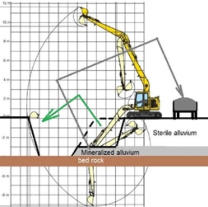
Here
is
a
rational
operation
with
a
hydraulic
shovel
with
long
arms.
A
second,
smaller
shovel
must
load
the
trucks that bring the mineralized gravel.
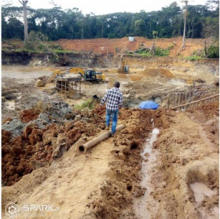
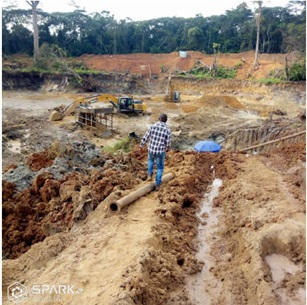
Productivity will then be an impressive factor compared to the exploitation of this photo taken by our
The
strategy
is
then
to
unite
the
diggers
in
a
cooperative
that
will
establish
an
irrevocable
cooperation
agreement with Mbomo-Mountains sarl in order to create a win-win association.
Mbomo-Mountains
sarl
finances
the
equipment
and
trains
the
diggers,
and
markets
the
production
and
takes its fair remuneration.
This
strategy
is
in
line
with
the
World
Bank's
wishes
to
ban
mercury
pollution
widely
used
by
diggers
for
amalgamation
concentration.
Once
the
gold
is
amalgamated,
mercury
is
often
evaporated
without
any
protective measures or recovery.
The
interest
for
Banalia-mining
sarl
is
to
create
the
best
harmony
with
the
population
in
order
to
promote the development the mining permits.
The
recruitment
of
personnel
to
carry
out
geochemical
prospecting
and
prospecting
by
drilling
will
be
done
mainly
among
these
artisan
miners
who
will receive the appropriate training.
As
soon
as
a
reserve
is
located,
we
will
begin
mining
it
with
a
small
CIL
cyanidation
plant, the FOB cost of which in China is less than $500,000.
The
annual
value
of
a
daily
production
of
120
tons/day
will
produce
more
than
5,000
ounces/year
and
an
annual
profit
of
more
than
$10
million,
allowing
us
to
continue
development through self-financing.
An
initial
location
of
50,000
ounces
will
be
found
quickly,
as
it
will
be
guided
by
geological
information
from
the
four
colonial
companies
available
at
the
Tervueren
Museum.
Once this location has been found, production will begin.
A concentration unit must be located as close as possible to the operation.
As the 1,200 km² of the 3PRs are prospected, other production units will be installed in order to achieve an annual production of over 100,000 oz.
The elution of the activated carbon on which the gold has been adsorbed will be carried out in a secure central unit.
The
exploration
of
the
1,200
km²
of
the
3PR
will
therefore
be
self-financed
over
the
life
of
the
operation,
and
it
is
certain
that
more
than
2
Moz
of
gold
reserves will be discovered.
















Ir Pol HUART
Alluvial
gold
was
mined
during
the
colony,
before
1960,
by
4
colonial
companies.
At
that
time,
most
of
the
prospectors
was
involved
in
alluvial
and
veins
of
quartz
and
ignored
the
dissiminated
gold.
The
most
attractive
deposits
in
the
region
are
disseminations.
They
occur
in
chemically
responsive
rocks
:
typically
carbonates
and
pyritic or graphitic facies.
Gold
reacts
in
BIFs
(Banded
Iron
Formation)
in
a
combination
of
chemical
barrier
(iron
oxides)
and
the
high
tectonic
competence
of
the rocks.
These
mining
permits
cover
the
same
geological
environment
as
the well known gold deposits in eastern of DRC.
This
unexplored
gold
deposit
should
interest
mining
companies
at
a
time
where
gold
is
being
discovered
at
a
fraction
of
the
rate
needed to replenish reserves.
Models and Exploration Methods for Major Gold Deposit Types
There
has
been
significant
progress
in
the
last
decade
in
the
understanding
of
the
geology,
settings
and
controls
of
the
diverse
types
of
gold
deposits,
including
the
recognition
of
new
deposit
types
in
new
environments.
Such
progress
has
been
paralleled
with
the
development
of
data
integration,
processing
and
visualization
techniques,
and
of
advances
in
geophysical,
geochemical
and
spectral
detection
techniques.
Geologists
are
now
better
equipped
than ever to face the increasingly difficult challenge of finding gold.
However,
one
of
the
key
lessons
of
the
last
decade,
as
reminded
by
Sillitoe
and
Thompson
(2006),
is
that
the
exploration
work
needs
to
remain
grounded
in
geology,
especially
in
the
field,
and
the
elaborate
detection
techniques
and
tools
available
will
only
find
their
full
power
when
closely
integrated
with
a
good
geological
framework.
Mining cooperative project to assist artisanal miners
This
project
is
part
of
the
World
Bank's
policy
of
leading
the
Mining
Sector Support Project, called PROMINES
(cf
http://www.prominesrdc.cd/
)
On
the
report
on
Improving
Artisanal
Gold
Mining
in
the
DRC
published
on
http://www.prominesrdc.cd/fr/Rapport/PROMINES
KEVIN TELMER final.pdf,
we read:
"It
is
estimated
that
about
80%
of
DRC's
gold
comes
from
informal
operations
of
artisanal
gold
mining,
although
the
actual
production
figure
is
unknown.
If
an
official
figure
of
industrial
gold
production
of
10
tonnes
is
used,
the
implication
would
be
that
the
artisanal
sector
produces
80%
more,
thus
50
tons
of
gold."
We
believe
that
artisanal
production is much more important..
Congolese
legislation
has
created
very
favourable
conditions
for
bringing
artisan
diggers
together
in
cooperatives.
It
is
still
necessary
to
motivate
the
diggers
to
join
these
cooperatives
which
allows
to
leave
the
informal
domain
and
join
the
formal
domain
that
benefits
the development of the country.
The
only
way
to
do
this
is
to
provide
the
cooperative
with
the
right
techniques
for
exploitation
and
recovery
as
well
as
the
right
equipment to drastically increase productivity per digger.
First,
alluvials
or
evaders
must
be
prospected
by
wells
to
establish
the
depth
of
the
unsealed
gravel
and
the
height
of
the
mineralized
gravel.
The
non-mineralized
cover
must
be
moved
to
an
already
exploited
area
while
mineralized
gravel
must
be
transported
to
a
concentration station where water is available.
Here
is
a
rational
operation
with
a
hydraulic
shovel
with
long
arms.
A
second,
smaller
shovel
must
load
the
trucks
that
bring
the
mineralized gravel.
Productivity
will
then
be
an
impressive
factor
compared
to
the
exploitation shown on this picture :
The
strategy
is
then
to
unite
the
diggers
in
a
cooperative
that
will
establish
a
cooperation
agreement
with
Mbomo-Mountains
sarl
in
order
to
create
a
win-win
association.
Mbomo-Mining
sarl
finances
the
equipment
and
trains
the
diggers,
and
markets
the
production
and
takes its fair remuneration.
This
strategy
is
in
line
with
the
World
Bank's
wishes
to
ban
mercury
pollution
widely
used
by
diggers
for
amalgamation
concentration.
Once
the
gold
is
amalgamated,
mercury
is
often
evaporated
without any protective measures or recovery.
The
interest
for
Banalia
Mining
sarl
is
to
create
the
best
harmony
with
the
population
in
order
to
promote
the
development
the
mining permits.
The
recruitment
of
personnel
to
carry
out
geochemical
prospecting
and
prospecting
by
drilling
will
be
done
mainly
among
these
artisan
miners who will receive the appropriate training.
Gold project (target 2MozAu)